
Measures for the employee against exposure to asbestos when making connection to AC pipe by punching
Before you begin
- You may only execute the work activities if you have attended ‘working safely with asbestos cement pipes' training.
- If the circumstances deviate from the work plan: Cease the work activities and contact the person responsible for the work.
- Before you begin check that refuse sacks, a suitable liquid water-based binding agent (such as latex), including equipment for its application, and asbestos waste container(s) are available.
- In addition to the required company clothing, use the following personal protective equipment:
- safety boots (type S5)
- neoprene (disposable) gloves
- For cutting into the pipe you should also wear:
- a disposable overall for once-off use (class 5 or 6).
- a full face filter mask P3
- Do not eat, drink or smoke within the designated workplace.
- The work activities must be executed in such a manner that no more than 2 employees are directly involved.
- Ensure that the pipe remains covered with approximately 5 -10 cm soil, until you begin work on the pipe.
- Keep the pipe or socket moist during the metal removing work activities.
- For splitting parts of the pipe use only the following equipment:
- a sledge hammer (preferred method);
- a chain cutter for the sections of pipes with an inner diameter of less than 300 mm;
- pneumatic or electrically powered saw. The saws must fulfil the following conditions:
- a rotating saw must not have a rotational frequency higher than 100 revolutions per minute;
- a backward and forward motion saw must not have a linear sawing speed greater than 25 meters per minute.
- Use a closed drilling tool for drilling gas pipes.
- With all work activities, ensure that the breaking and cutting surfaces are moist.
During the work
- Release the pressure of the pipe using blowers.
- Clean and wet the pipe.
- Place the drilling tool saddle on the pipe.
- Mount the valve organ (valve or one-way valve) on the saddle.
- Pour a quantity of approximately 0.2 litres of water into the valve organ.
- Assemble the drilling tool and open the pipe.
- Immediately store the drilled out asbestos cement disc in a plastic sack labelled ‘asbestos’.
- Remove the drilling tool and clean it thoroughly with water.
- Apply the blowers via the valve organ in the pipe and pressurise them according to the manufacturer's instructions.
- If it is stated in the VIAG work plan that a second blower must be used, then repeat the above steps.
- Repeat the steps above on the other side of the pipe section which is to be depressurised.
- It is preferable to remove the whole pipe:
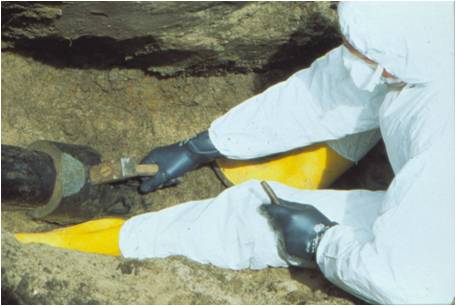
- Wet the sockets.
- Strike the sockets with the sledge hammer.
- Remove the whole pipe.
- Immediately collect and pack the broken pieces in plastic refuse sacks labelled 'asbestos'.
- Alternatively remove a section of the pipe:
- Thoroughly wet the pipe at the split/cutting point
- Strike the pipe with the sledge hammer (or cut or saw it).
- Grease or spray the ends of the split pipes immediately with a suitable water-based liquid binding agent (such as latex).
- Pack the pipe parts and the broken pieces in plastic refuse sacks labelled 'asbestos'.
- Thoroughly clean the peg ends of the AC-pipe or the pipe ends of the cut pipe with a soft brush and water.
- Fit the A, B or T pieces to be used together with the replacement pipe parts using fittings and special sockets which can compensate for differences in external diameters.
- Thoroughly clean the removed blowers and related equipment with water and paper or cloth. Remove paper or cloth with the other asbestos containing waste in a closed sack labelled ‘asbestos’ to the asbestos waste container.
- When you leave the workplace, throw the disposable overall, disposable gloves and the filter mask away in a refuse sack in the asbestos containing waste. Clean the mask. Place your safety boots and neoprene gloves at the edge of your work place.
- Wash your hands and arms, and also your face if you are going to eat or drink.
- If you are returning to your work place, then put on a new disposable overall and disposable gloves and put a new filter in the mask.
When the work is finished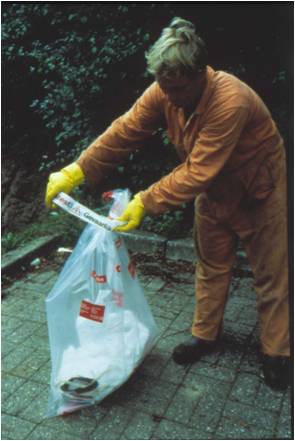
- After finishing the work activities inspect the workplace for any asbestos-containing waste which may have been left behind and collect and pack this in refuse sacks labelled ‘asbestos’.
- Clean the tools with water.
- Put the used disposable clothing and disposable gloves together with the filter mask in a plastic sack labelled 'asbestos', in the asbestos waste container.
- Rinse boots and neoprene gloves.
- Wash your hands, arms and face.
Oplossing voor:
Werknemer
Oplossing status:
Goedgekeurd door de Nederlandse Arbeidsinspectie
