
Measures for the employee against exposure to asbestos when removing AC-pipes
Before you begin
- You may only execute the work activities if you have attended ‘working safely with asbestos cement pipes' training.
- If the circumstances deviate from the work plan: Cease the work activities and contact the person who is responsible for the work.
- Before you begin check that refuse sacks, a suitable liquid water-based binding agent (such as latex), including equipment for its application and asbestos waste container(s) are available.
- Do not eat, drink or smoke within the designated work place.
- The work activities must be executed in such a manner that no more than 2 employees are directly involved;
- When working on or with the pipe use the following personal protective equipment:
- a disposable overall for once-off use (class 5 or 6);
- safety boots (type S5);
- neoprene (disposable) gloves;
- a full face filter mask P3 (dust mask, preferably a half-face mask).
- Ensure that the pipe remains covered with approximately 5 -10 cm soil, until you begin work on the pipe.
- Keep the pipe or socket moist during the metal removing work activities. Use only the following equipment:
- a sledge hammer (preferred);
- a chain cutter for the sections of pipes with an inner diameter of less than 300 mm;
- an electric or pneumatically powered saw or chain cutter for the sections of pipe whose inner diameter exceeds 300 mm. The saws must fulfil the following conditions:
- a rotating saw must not have a rotational frequency higher than 100 revolutions per minute;
- a backward and forward motion saw must not have a linear sawing speed greater than 25 meters per minute.
- With all work activities, ensure that the breaking and cutting surfaces are moist.
During the work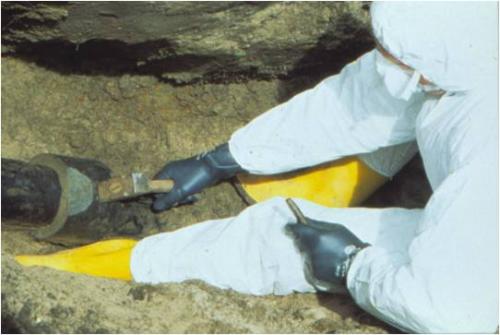
- Wet the socket after it has been manually excavated from the ground and break it with a sledge hammer.
- Do not strike more than one socket. If the piping is too long, you may break it at two points.
- Then pull the pipes – using an excavation machine fitted with clamps or lifting bands – out of the consecutive connection sockets and lift them out of the trench.
- When using lifting bands manually excavate the pipes at the points of contact.
- Visually inspect the released pipes for any chemical corrosion to the interior and exterior. If there is any chemical corrosion on the exterior, then pack the pipes in foil before the pipes are lifted out of the trench or immediately as soon as this is possible.
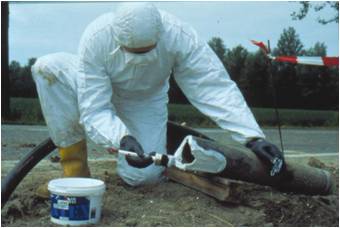
- Immediately collect any small broken pieces and pack them in plastic refuse sacks labelled 'asbestos'. Seal the sacks so they are air tight. As soon as possible after collecting the waste, in any case at the end of the working day, place it in the open asbestos waste container(s). If you cannot put the asbestos-containing waste immediately in an asbestos waste container, you must take measures to avoid unauthorised persons coming in to contact with the waste.
Grease or spray break surfaces and damage to pipes and pipe parts immediately with latex (water based). - If the local conditions are such that breaking with a hammer is not possible and you have to divide the pipes with a chain cutter or a saw, then you must limit this as much as possible.
- Avoid unnecessary breaking of pipes or loss of asbestos waste.
- Cover the asbestos waste containers with at least a tarpaulin and ensure they carry the warning 'caution: contains asbestos'.
- When you leave the workplace, throw the disposable overall, disposable gloves and the filter mask away in a refuse sack in the asbestos containing waste. Clean the mask. Place your safety boots and neoprene gloves at the edge of your work place.
- Wash your hands and arms, and also your face if you are going to eat or drink.
- If you are returning to your work place, put on a new disposable overall and disposable gloves and put a new filter in the mask.
When the work is finished
- After finishing the work activities inspect the workplace for any asbestos-containing waste which may have been left behind and collect and pack this in refuse sacks labelled ‘asbestos’.
- Clean the tools with water.
- Put the used disposable clothing and disposable gloves together with the filter mask in a plastic sack labelled 'asbestos', in the asbestos waste container.
- Rinse boots and neoprene gloves.
- Wash your hands, arms and face.
Oplossing voor:
Werknemer
Oplossing status:
Goedgekeurd door de Nederlandse Arbeidsinspectie
